Teaching Accent Softening and Elocution in the Arab World

First of all, the so-called Arab spring and subsequent chaos in many Arab countries have significantly narrowed the choice of places for a student from the West to learn and practice Arabic abroad. Nevertheless, Jordan, Lebanon, Morocco and Oman – countries who remained largely unscathed by the revolts and anarchy – still offer a number of decent institutions to learn and practice Arabic. Characteristically, the Gulf countries as places of teaching Arabic for foreign students were conspicuous by their absence on the map published by Saudi Al-Arabiya TV channel several years ago[1]. It is, indeed, very much true today as an attempt to learn Arabic in, for example, the UAE would be a pure waste of time and (much) money.

Secondly, even well-established institutions in the Arab world do not offer special courses for elocution and accent softening[2]. It is quite strange for a non-native speaker from, for example, the UK where the accent softening classes are offered throughout the country and shelves of books have been published on this topic. On the other hand, the accent reduction, phonetics and elocution in Arabic are generally absent in the curricula of the universities where Arabic is taught in the Western countries. Obviously, there is a clear need for such a training both in the West and in the Arab countries.

The situation with the textbooks on this topic is no better. So far, I have not come across of any specific textbook which would provide a concise plan how to soften/eliminate the accent and improve the pronunciation. There is, however, a significant number of books which tackle the theoretical aspects of Arabic phonetics[3] while offering no practical advice and exercises.

As I have been learning Arabic for 9 years, first in the university in Germany and then in a number of teaching institutions in Morocco, Egypt and Jordan, I have encountered a total understanding for the need of special courses in Arabic phonetics. As one teacher put it recently “We need it badly and to be honest with you, I have this idea in mind all the time. The problem is with textbooks and expertise” – which was very much to the point.


[1] Faith Barker: “Top places to learn Arabic in the Middle East” Al Arabiya News, December 26, 2013. Available at: http://english.alarabiya.net/en/life-style/art-and-culture/2013/12/26/Top-places-to-learn-Arabic-in-the-Middle-East.html

[2] The only exception is, to my knowledge, Al-Jazeera Media Training and Development Center in Doha which offers a 5-day course for TV and radio presenters entitled “Skills of Voice Placement & Elocution”. Unfortunately, it is not a pure accent softening course for non-native speakers.  In addition, the fees of $2000 are hardly affordable for an average student

[3] For example, “Phonetics” (علم الاصوات)by Doctor Kamal Bashar (بشر كمال)
Fossil Fuels in the Arab World: Seasons Reversed – Oil and Politics Interplay in the Arab World

New book reflects on the interplay between politics and the oil and gas industry in the Arab world.

In the previous book “Fossil Fuels in the Arab World: Facts and Fiction”, an assessment was undertaken of mankind’s dependence on fossil fuels i.e. oil, natural gas and coal – particularly the position of Arab countries in this international industry. It evaluated commonly held beliefs, separating the hard facts from fiction by analysing the data and examining them impartially to provide a definitive, quantitative, answer, and through the perspective of a political lens. In addition, the book examined the interaction between fossil fuels and alternative energy. In concluding the book several questions were posed, identifying whether or not fossil fuel producing countries of the Arab world were an indispensable energy supplier and if the answer or beliefs around that question were affecting Western policies towards the Arab world.

This book answers these questions posed five years ago, placing them into “three perspectives”: market fundamentals, understanding the fossil fuel market fundamentals and the place of the Arab world within that; political influences, corruption & cultural norms in business dealings, the developing democracy and militarisation in the Arab world and their interplay with oil and gas, and finally, public relations, perceptions or concerns, where climate change and alternative energy questions are explored in detail.

This book is written in a non-technical style to appeal both, to the non-expert with no prior knowledge of oil and natural gas, and also to the oil and gas experts, who are interested in further insights on the future of Arab world and its oil and gas sector.

This book is structured into three parts totalling seven chapters. Part I consists of two chapters and reviews briefly the events of the last five years and puts them in context, then revisits the conclusions in the previous book, and examines if they still stand, providing a current update. Part II is the core analysis consisting of four detailed chapters, in which answers to all eight questions from the previous book are provided. Sets of data addressing the “three defined perspectives” are also presented. Finally, Part III is the concluding chapter, which connects all the threads of the analysis and looks at the bigger picture. Here again, more questions are asked and predictions offered of what is likely to happen in the future.

The book is now available worldwide at reputable bookstores and online book retailers.

Full Details:
Paperback: 268 pages
Publisher: 2050 Consulting, +44 20 7490 2942
Language English
ISBN-10: 0956736815
ISBN-13: 978-0956736819
Retail price: £21.99
URL: http://books-fossilfuels.2050consulting.com

Spectacular Facilities and Stunning Buildings Are Not Enough – The Low Ranking of Arab Universities

With high school exam results out in many countries, I was contacted by friends seeking advice regarding which universities I can recommend to send their family members. With background working in academia I kept a close eye on developments in the higher education system worldwide, and often follow the diverse rankings published annually by magazines, newspapers, websites, institutions, governments, or academics ranking entire establishments globally, regionally or nationally, as well as more detailed rankings listing programs, departments or schools.

Taking a look at the latest lists from different sources, I felt sad how low Arab Universities are ranked. I find it painful that despite the vast sums of money Arab countries spend on the sector, and the expanding campuses occupying hundreds of acres, and hosting splendid infrastructure, exquisite buildings and state of the art technology, the research outcome and the teaching quality leave a lot to be desired.

In the table below I summarise the results I obtained from the major higher education ranking sources, and compare the Arab world’s results with those for institutions in Singapore (a country with approximately 10% and 1.5% of the Arab world’s GDP and population respectively). I also compare the results with the rankings for institutions in Israel, a country Arabs like to bench themselves against.

Table 1: Highest ranking university in the Arab world, Singapore and Isreal

Country /Region

Rankings

QS University Times Higher Education

Shanghai

Arab world

173

201-250 101-150
Singapore

11

24

91

Israel

145 186

93


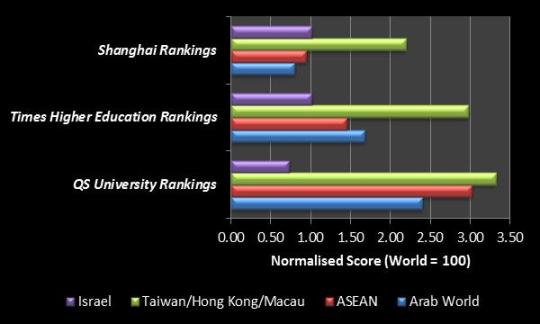
In the graph below, a normalised score is shown comparing the scores of the Arab world to those in ASEAN or the trio of Taiwan/Hong Kong/Macau, and to Israel.

Education_Ranking_2017

Figure 1: Normalised ranking score in several regions/countries

The results above are a snapshot, and I have no judgment on which ranking is the better list or the pros and cons of any of the rankings or their methodologies.

I write this not as a form of self-abasement, pity, or disrespect, but rather as a wake-up call hoping that some egos will be stimulated to wipe out the shameful results and act to rectify the situation. I live in hope.

The Dead Sea Dying Saga

For a period of eight years between 1996 and 2004, I followed closely the environmental catastrophe unfolding in the Dead Sea. My interest inspired me to develop a model and write-up a PhD to look closely at the issues and how can they be solved.

While I moved on to pursue other interests, I kept a close eye on the story, and I am still astounded that despite decades of talk, numerous studies and conferences nothing have been done.

The question of whether the Dead Sea will die, and if the answer is positive, the timing of this tragedy, generated megabytes of data resulting in hundreds of articles and publications. However, to date, there is no consensus on an answer. Scaremongering dominates.

While my previous research suggested that the Dead Sea will not die in 50 years, some of the scenarios I considered suggested a slow death is a possible eventuality.

I may be tempted in the next few months to reignite my interest in the subject, but for now, I am just listing my previous research so that it can be accessible. Below you can find links to my past published and unpublished work, some of which is downloadable.

Media Reporting… Fact or Fiction? The Dead Sea Canal Case, BRISMUS Annual Conference, London (2004)

The Dead Sea is Unlikely to Dry up in 50 Years, EOS Transactions – American Geophysical Union, 85, 69 & 73 (2004)

The science and politics of the Dead Sea – Red Sea Canal or Pipeline, Journal of Environment and Development, 12, 325-339 (2003)

Effect of the Dead Sea – Red Sea Canal Modelling on the Prediction of the Dead Sea Conditions, Hydrological Processes, 17, 1607-1621 (2003)

Scientific Insight into the Dead Sea – Red Sea Canal, University of Jordan Publications (2003)

The Dead Sea and the Changing Climate, The Star, 14, September 4-10, 12 (2003)

The Dry-up of the Dead Sea [in Arabic], Ad-Dustour, 12980, 4 (2003)

Who claimed the Dead Sea will dry-up? [in Arabic], Al-Rai, 12043, 17 (2003)

A Scientific View of the Dead Sea Canal Project [in Arabic], Asharq Al-Awsat, 9010, 20 (2003)

Environmental Effects of the Dead Sea – Red Sea Canal, International Journal of Environmental Studies, 59, 647-664 (2002)

Long Term Prediction of Water Level and Salinity of the Dead Sea, Hydrological Processes, 16, 2819-2831 (2002)

Prediction of the Dead Sea Dynamic Behaviour with the Dead Sea – Red Sea Canal, Advances in Water Resources, 25, 783-791 (2002)

Dynamic Simulation of the Dead Sea, Advances in Water Resources, 25, 263-277 (2002)

Estimation of Evaporation from the Dead Sea, Hydrological Processes, 13, 2743-2750 (1999)

Correlation! Correlation!

Following Theresa May’s decision to call snap elections in the UK in April 2017, several articles were published in the sports media claiming that the English Premier League title was over and proclaiming that Chelsea has won it. In actual fact, Chelsea were flying high at the top of the table by then and went to clinch the title. In April few were betting against them. However, the stories published were coming from a different angle, and their authors made their predictions by correlating the UK election years with the Premier League winners (e.g. Does this year’s election mean Chelsea have already won the title? & The freaky fact that links Chelsea and the General Election).

While the story can be amusing for few seconds, I find it odd that people can get away with generating headlines manipulating statistics and generating meaningless correlations. This practice is on the rise in sports’ related media, and the facts go often unchecked.

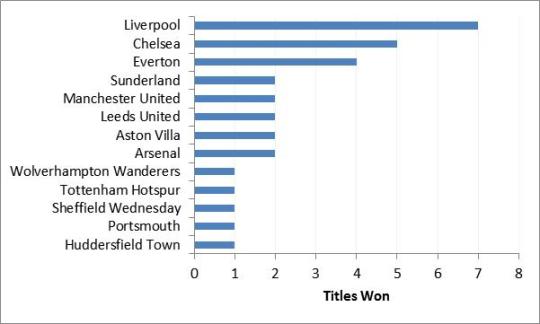
Here I just present the facts to prove that any claims relating winning premier league title to UK election year are nonsensical. Since the start of the English Football League in 1888, the top tier competition was contested 118 times. In the same period, 33 UK general elections took place. As can be seen in Figure 1 below 13 different teams won the title, with Liverpool winning it on 7 different occasions. Looking at the graph illustrates that no correlation exists.

Chelsea_Election_1

Figure 1: Number of Football Tier 1 title wins by team in UK election years

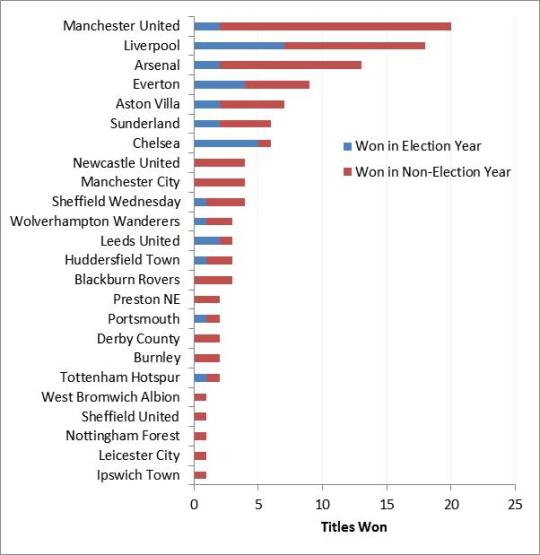
Extending the analysis further, results in Figure 2 show that 24 teams have won the title, with just over 50% winning it in an election year sometimes. It can be seen the team with the most wins Manchester United only won 2 titles in an election year, that’s a 10% rate, while Manchester City won 4 times, none of which happened in an election year. It is only a coincidence that Chelsea won 5 titles in election years with 83.3%, and no conclusions need to be drawn from this.

Chelsea_Election_2

Figure 2: Number of Football Tier 1 title wins by team

I leave it to the readers to make-up their minds prior to believing these pseudo-statistical relationships, and trust headlines designed to grab attention.

Deal or No Deal? Natural Gas Supplies to Jordan

1. Introduction[1]

As a Jordanian expat, with a keen personal and professional interest in the energy policies in Jordan, I have been closely following the debate in the Jordanian media over the last few months regarding the supply of natural gas from Israel to Jordan. I have been exasperated by the amount of misinformation published and flabbergasted by claims made by so-called experts, who fabricate facts to deceive the public. I am not in a position to speculate what their motives might be but their actions have motivated me to write this piece and set the record straight.

There is a need to analyse the topic objectively, setting emotions, reactions and feelings aside. We must all be mindful of the facts and refrain from making fanciful claims.

Let us remember that this natural gas trade deal is not the first of its kind and history is full of examples where previous enemies collaborated, or even current enemies worked together for the greater good of both those interests. Recall that, at the peak of the Cold War, the Americans supplied the “evil” Soviets with their wheat needs and the Soviets supplied European NATO countries with the natural gas necessary to keep their economies rolling. Another notorious example was when Iran sourced its weapons from the so-called-then “Great Satan”, i.e. the USA and Israel, during the Iran-Iraq War in the 1980s. Sometimes in politics, “the enemy of my enemy is my friend”, and, “money makes the world go round”.

Bearing this in mind, let’s go back to the Jordanian-Israeli situation, take a brief overview of the state of the energy/power supply and demand in Jordan, then let’s analyse the need for, and logic behind, the natural gas deal. Then let’s look at all the alternative solutions proposed in the media to this natural gas deal.

Continue reading

Measuring Election Fairness: A New Approach

Measures or indices to quantify elections’ disproportionality have been widely proposed in literature and used extensively to analyse and compare election results. This study introduces the Unfairness Index (UI) as a generalised versatile easy-to-use disproportionality index. UI satisfies 11 out of 11 criteria proposed by Taapegara and Grofman (2003), which are considered desirable for any disproportionality index, and thus it scores higher than the scores of Loosemane-Hanby Index (LHI) and Galleger Index (GhI). UI is bound between 0 and 1 (0 and 100%), with 0 indicates no disproportionality. Applying UI to elections in the UK and ten other countries for the period 1979-2011 established that UI not only agrees with LHI and GhI in its assessment regarding election disproportionality, it also interprets better the unfairness in an election compared to LHI and GhI.

Download the full article: pdf_iconMeasuring Election Fairness: A New Approach

لماذا يشترون نفطنا ؟

1 المقدمة

أدت الاضطرابات التي تجتاح العالم العربي حالياً إلى ارتفاع أسعار النفط لمستويات لم يصلها منذ العام 2008، و أبرزت المسألة الشائكة المتمثلة في الإعتماد العالمي على النفط العربي على صفحات الصحف وفي مقدمات نشرات الأخبار في كافة أرجاء العالم. و قد أدى هذا الهجوم الإعلامي المصحوب بتحذيرات مستمرة من قبل الخبراء عن حدوث نقص وشيك في مصادر الطاقة والذي يكون عادة مصحوباً بادعاءات يذكيها الكثير من المتوجسين المدافعين عن نظرية “ذروة النفط” – والذين يروجون لفكرة أن انتاج العالم من النفط قد وصل القمة (الذروة) وبأن نفاذه السريع قد بدأ – إلى إقناع الجمهور العالمي بشكل لا لبس فيه بأن العالم العربي هو مصدر للطاقة لا غنى عنه، و بدون هذا المصدر سيكون مصير الحضارة الإنسانية التوقف ثم الانهيار. هذه التحذيرات والادعاءات كثيراً ما استخدمت ومازالت تستخدم كذريعة لتبرير استمرار التدخل السياسي والعسكري في شؤون العالم العربي، واستعملت مراراً وتكراراً من قبل قادة الديمقراطيات الغربية كسبب للدفاع عن دعمهم للحكومات الاستبدادية والسلطوية العربية لضمان استمرارها في الحكم. ومع انه يبدو على السطح بأن هذه المواقف الغربية قد تغيرت بسبب الثورات العربية عام 2011، إلا أنه في واقع الأمر، ما زالت المواقف الغربية ثابتة ولكنها أصبحت مغلفة بالسرية والحذر. وهنا لابد من التساؤل: هل العالم هشٌ حقاً لهذا الحد؟ وهل تعتمد الحضارة الإنسانية على منطقة واحدة غير مستقرة من العالم لتأمين إمدادات الطاقة العالمية؟

للإجابة على الأسئلة المطروحة أعلاه، يتبع هذا المقال نهجاً واضحاً معتمداً على أساس التدقيق في الأرقام والمعلومات، عوضاً عن قبول الإدعاءات غير المثبتة والتي لا أساس لها من الصحة غالبا. و لتحقيق هذا الغرض نستعرض أدناه أربع محاور رئيسية  تساعدنا على رسم خارطة طريق للتفكير والتي بدورها ستقود إلى استنتاجات واضحة وتؤهلنا للحصول على رؤية واضحة ورأي مضطلع يمكننا من التفريق بين الحقائق والخيال عند قراءة وتفسير المعلومات حول هذا الموضوع.

  1. دراسة كافة أنواع الوقود الاحفوري، أي النفط والغاز الطبيعي والفحم، والتي تشكل الغالبية العظمى من احتياجات الطاقة العالمية. هذا يعني انه لا يجب علينا الاكتفاء بدراسة بيانات النفط فقط، بل توسيع ذلك ليشمل بيانات الغاز الطبيعي والفحم، حيث أن هذه الأنواع الثلاثة من الوقود قابلة للتحول من شكل إلى آخر من الناحية التقنية، وبناء عليه، لابد من دراستها مجتمعة.
  2. الاعتراف بالمصادر غير التقليدية من الوقود الاحفوري، والتي تستمر عملية إعادة تصنيفها تدريجياً وبمرور الوقت كمصادر تقليدية بسبب التقدم التكنولوجي، مما يجعلها مجدية اقتصادياً. وتشمل مصادر الوقود الاحفوري غير التقليدية النفط الثقيل، ورمال القطران، و الصخر الزيتي, والغاز الحجري، الغاز المحصور، الميثان في الطبقات الفحمية, (coalbed methane) الغاز المضغوط بواسطة عوامل جيولوجية  (geopressurised)و الغاز المضغوط بواسطة السوائل (hydropressurised gas) وهيدرات الميثان والجفت.
  3. الفهم الواضح لمصطلحات الوقود الاحفوري الأساسية، والقدرة على التمييز بين أنواع الوقود ، و التمييز بين مصطلحي “الاحتياطيات” و”الموارد”.
  4. إجراء تقييم دقيق ومحايد لاحصاءات الوقود الاحفوري في العالم العربي ومساهمته  في خريطة الطاقة العالمية. هذا التقييم يجب أن يعتمد على مصادر بيانات موثوقة وشاملة، بيانات مقومة ليس على أساس الدقة والموثوقية فحسب بل على أساس الموضوعية ومعرفة دوافع مقدمي البيانات أيضا.

Continue reading

Can the Arab Uprising Topple Western Democracy? Change and Affect Western Way of Life?

1. Introduction

The turmoil currently engulfing the Arab world causing oil prices to soar has once again brought the thorny issue of the global dependence on Arab oil to the forefront of news bulletins and newspapers worldwide. The continuous blitz by the “experts” warning of imminent energy shortages, chiefly the scaremongers advocating looming “peak oil” where the world will be running out of oil, has lead the public globally to unequivocally be persuaded that the Arab world[1] is an indispensable energy source without which civilisation will come to a halt and collapse. This perspective is often used as a pretext to justify continuous political and military meddling in the Arab world’s affairs. It has repeatedly been used by “democratic” western leaders to defend their support of autocratic and authoritarian Arab governments to stay in power. This attitude appears to be changing on the surface due to the Arab uprisings of 2011, yet in reality, it is still being maintained, though cautiously discreet. But is the world really this vulnerable? And does civilisation rely for its energy supplies on what happens in one unstable region in the world?

To answer the above questions, this article is informed by hard facts and follows a clear approach based on scrutinizing the numbers rather than accepting the propaganda that often has no basis. As such, the four steps outlined below are crucial to establish a roadmap of thinking leading to clear conclusions:

  1. Incorporating fossil fuels as a whole, i.e. oil, natural gas and coal, which constitute the overwhelming majority of the world’s energy needs. This means that we have to widen the data review beyond oil to include natural gas and coal, since the three fuel types are technically convertible. Accordingly, it is crucial to inspect them comprehensively.
  2. Embracing unconventional forms of fossil fuels, which continue to be gradually reclassified over time into conventional due to improving technology, which renders them economically feasible. These include extra heavy oil, tar sands (bitumen), oil shale, shale gas, tight gas, coalbed methane, geopressurized and hydropressurised gas, methane hydrate and peat.
  3. Attaining an unambiguous and basic understanding of the terminology and concepts of fossil fuels, distinguishing fuel types and clarifying the jargon, in particular, the distinction between the terms “reserves” and “resources”.
  4. Assessing impartially fossil fuels statistics in the Arab world and their contribution to the global picture. This assessment must rely on credible and comprehensive sources of data included where not only the accuracy and reliability of the data is important, but also the motivation and objectivity of its providers.

This article implements this road map and equips us to obtain a clear insight and an informed opinion, which allows us to differentiate facts from fiction when reading and interpreting data about this subject.

Continue reading

Fossil Fuels in the Arab World: Facts and Fiction – Global and Arab Insights of Oil, Natural Gas & Coal

New book dispels the myths and clarifies the facts about the dependence of the world on the Arab oil and gas.

Will the turmoil in the Arab world have severe consequences on global energy security? Is the Arab world an indispensable energy source without which civilisation will come to a halt and collapse? Is this the reason causing continuous political and military meddling in the Arab world’s affairs, and is being used by democratic western leaders to support autocratic and authoritarian Arab governments to stay in power? Is the apparent change in policy only superficial due to the Arab uprisings of 2011, yet in reality it is still being maintained discretely? Is the world really this vulnerable? Does our civilisation rely for its energy supplies on what happens in one unstable region in the world?

To paint a true picture of mankind’s dependence on fossil fuels, particularly oil, and to assess the position of the Arab world in this picture, the above questions and more are answered by analysing not only oil, but the three types of fossil fuels: oil, natural gas, and coal, which are in essence convertible, Fossil fuels are tackled from two main angles; the first angle is the need to clarify the terminology and the terms used by the media, the politicians, the scientists, and the so-called experts, when discussing oil, natural gas and coal, while the second angle is to evaluate the hard facts and separate them from fiction by analysing the numbers and scrutinise them impartially to come with a definitive quantitative answer. Finally, a further investigation examines fossil fuels in relation to alternative energy, and from a political perspective.

This comprehensive book is written in a non-technical style to appeal both to the non-expert with no prior knowledge of oil, natural gas or coal, as well as oil and gas experts, who require detailed analysis of fossil fuels availability and future in the Arab world.

The book is now available worldwide at reputable bookstores and online book retailers.

Full Details:
Paperback: 396 pages
Publisher: 2050 Consulting, +44 20 7490 2942
Language English
ISBN-10: 0956736807
ISBN-13: 978-0956736802
Retail price: £20.99
URL: http://books-fossilfuels.2050consulting.com